
Serious Misconduct as a Just Cause for Dismissal
Serious misconduct is one of the most commonly invoked, yet most misunderstood, just causes for dismissal under Philippine labor law. While the Labor Code allows employers to terminate an employee for “serious misconduct” in connection with work, the Supreme Court has consistently required that the act be grave, work-related, and done with wrongful intent before dismissal can be upheld. This article explains the legal test for serious misconduct and illustrates it through key Supreme Court decisions.
Atty. Jason Oliver Sun
1/3/20263 min read


Serious misconduct is one of the most frequently invoked just causes for dismissal under Philippine labor law. It is a ground that, when properly established, allows employers to terminate employees who have committed grave offenses in the workplace. However, the law and jurisprudence set a high bar for what constitutes “serious misconduct,” ensuring that the right to security of tenure is not lightly disregarded.
Legal Definition and Elements
Under the Labor Code, as amended, an employer may terminate an employee for “serious misconduct or willful disobedience by the employee of the lawful orders of his employer or representative in connection with his work.” Jurisprudence has consistently defined misconduct as a “transgression of some established and definite rule of action, a forbidden act, a dereliction of duty, willful in character, and implies wrongful intent and not mere error in judgment.” See Sterling Paper Products v. KMM-Katipunan, G.R. No. 221493, August 2, 2017; Rivera v. Genesis Transport, G.R. No. 215568, August 3, 2015; University of the Cordilleras v. Lacanaria, G.R. No. 223665, September 27, 2021.
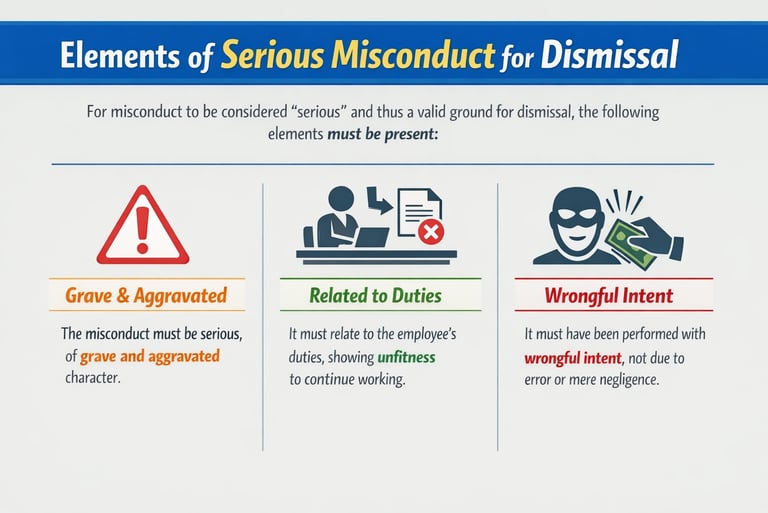
For misconduct to be considered “serious” and thus a valid ground for dismissal, the following elements must be present:
The misconduct must be serious, i.e., of grave and aggravated character.
It must relate to the performance of the employee’s duties, showing that the employee has become unfit to continue working for the employer.
It must have been performed with wrongful intent, not merely as a result of error in judgment or simple negligence.
Illustrative Cases
1. Obscene or Offensive Conduct
In Sterling Paper, the Supreme Court upheld the dismissal of an employee who uttered obscene and insulting words against a superior in the presence of co-employees. The Court emphasized that such acts are not only destructive of morale but also constitute gross misconduct, especially when committed willfully and in connection with work.
2. Violation of Company Rules and Dishonesty
In Perez v. JP Morgan Chase Bank, G.R. No. 256939, November 13, 2023, an employee was dismissed for participating in profane conversations using company resources and for unauthorized transmission of company information to a personal email. The Court found these acts to be serious misconduct, particularly because the employee was expected to uphold company policies.
3. Single, Isolated Errors
The Supreme Court has cautioned that a single, isolated error or minor discrepancy, absent evidence of ill-motive or a pattern of misconduct, might not amount to serious misconduct. The gravity, frequency, and circumstances of the act must be considered, and doubts are resolved in favor of labor.
4. Requirement of Willfulness
In Citigroup Business Process Solutions v. Corpuz, G.R. Nos. 208738-39, June 5, 2024, the Court stressed that serious misconduct, willful disobedience, and fraud all require “willfulness” or “wrongful intent.” Simple negligence or honest mistakes do not justify dismissal on these grounds.
Procedural Due Process
Even when serious misconduct is established, employers must still comply with procedural due process, typically the two-notice rule. Failure to do so may entitle the employee to nominal damages, though not necessarily reinstatement or backwages.
Conclusion
Serious misconduct as a just cause for dismissal is strictly construed. Employers must prove not only the commission of a grave offense but also that it was willful, related to the employee’s duties, and rendered the employee unfit for continued employment. The Supreme Court’s consistent pronouncements ensure that this ground is not abused, balancing management prerogative with the constitutional right to security of tenure.
Disclaimer: This article was prepared with the assistance of artificial intelligence and may contain errors. It is intended solely for educational and informational purposes. It does not constitute legal advice, nor does it create an attorney-client relationship. Readers should note that the applicable laws and jurisprudence may vary depending on the specific facts of each case.
For advice regarding your particular circumstances, please consult our qualified legal professionals at Sun Law Office.
Contact
info@sunlawoffice.com
© 2026. All rights reserved.
Sun Law Office