
Willful Disobedience as a Just Cause for Dismissal
In the Philippine workplace, employers are vested with the authority to issue reasonable and lawful orders to their employees. When an employee deliberately refuses to comply with such directives, the law recognizes "willful disobedience" or "insubordination" as a valid ground for termination. This blog post explores the legal standards for willful disobedience, supported by illustrative cases decided by the Supreme Court.
Atty. Jason Oliver Sun
1/3/20264 min read


The Philippine Labor Code, as amended, explicitly recognizes willful disobedience as a just cause for dismissal. Article 297 (formerly Article 282) provides: "An employer may terminate an employment for any of the following just causes: (a) Serious misconduct or willful disobedience by the employee of the lawful orders of his employer or representative in connection with his work."
Defining Willful Disobedience: Elements and Standards
Jurisprudence and implementing regulations have clarified that not all acts of disobedience warrant dismissal. For willful disobedience to constitute a just cause, two essential elements must be present:
The employee’s conduct must be willful—that is, characterized by a wrongful and perverse attitude, not merely inadvertence or simple neglect.
The order violated must be reasonable, lawful, made known to the employee, and must pertain to the duties which the employee has been engaged to discharge.
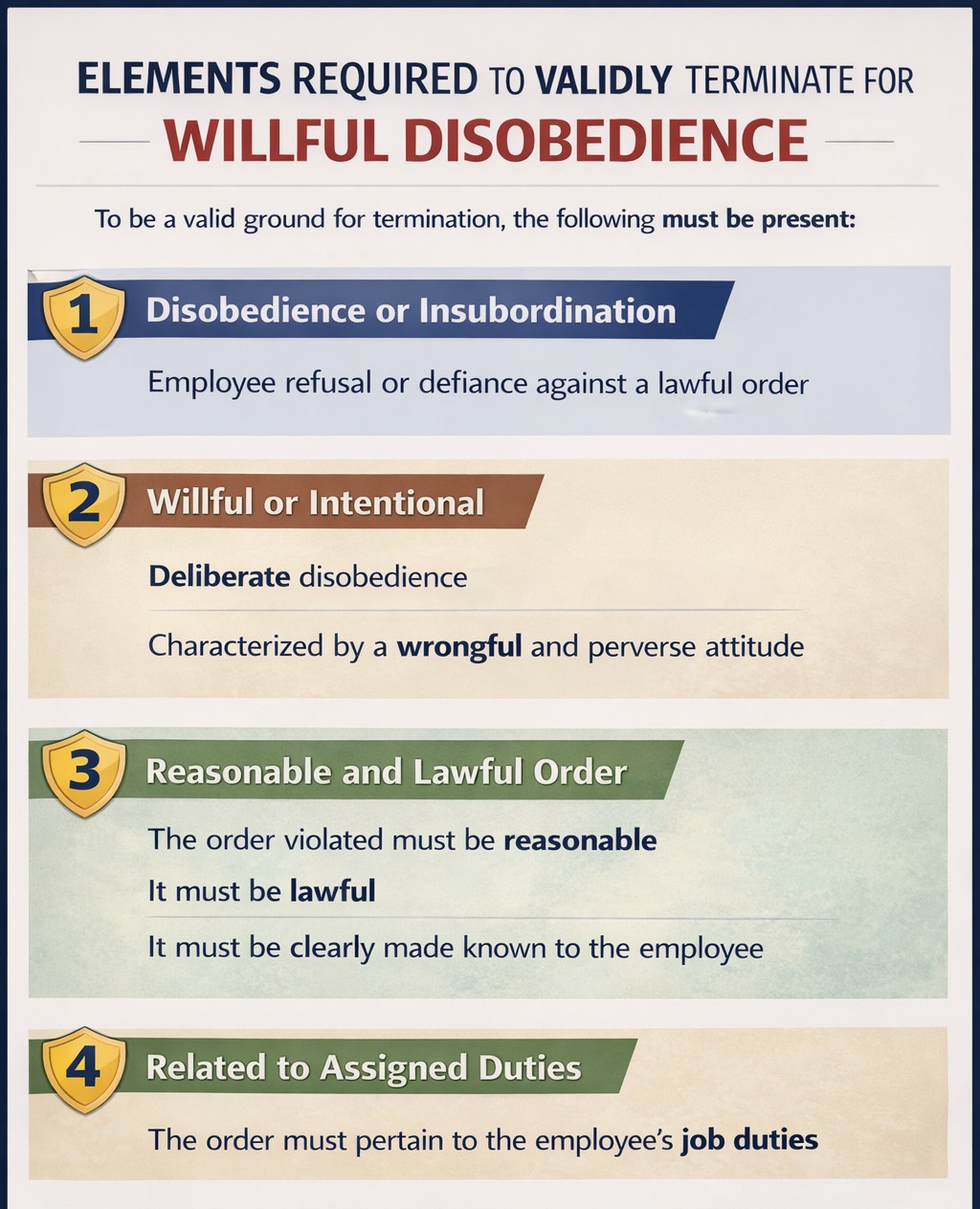
This standard is codified in the DOLE D.O. No. 147-15 (2015), which provides that:
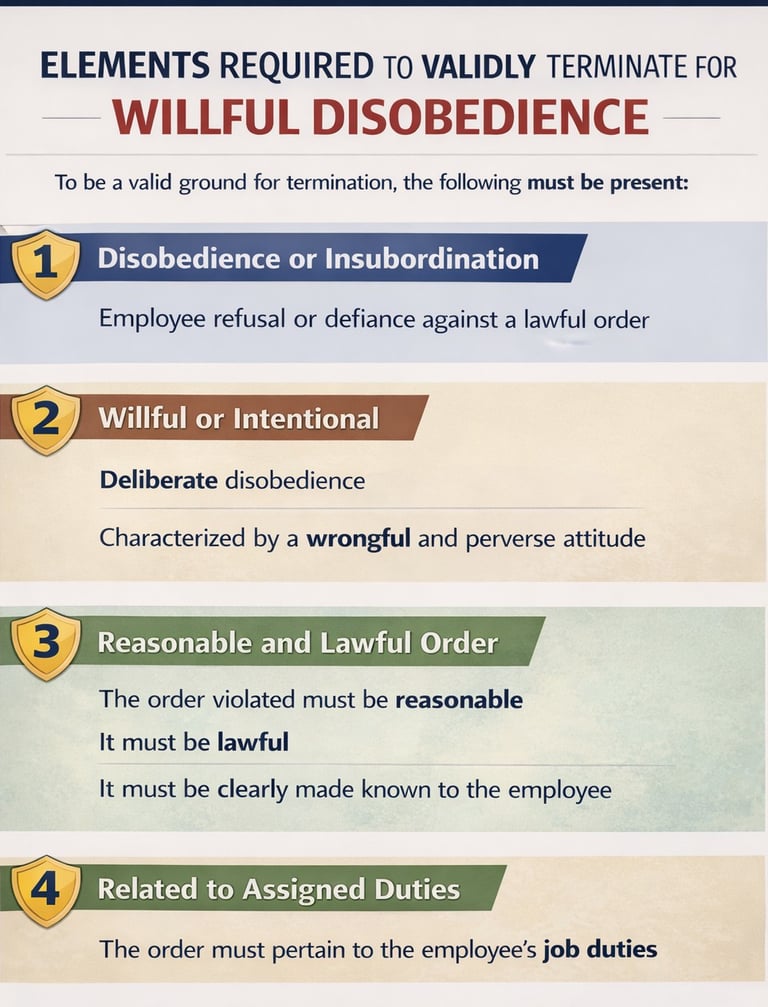
"To be a valid ground for termination, the following must be present:
There must be disobedience or insubordination;
The disobedience or insubordination must be willful or intentional characterized by a wrongful and perverse attitude;
The order violated must be reasonable, lawful, and made known to the employee; and
The order must pertain to the duties which he has been engaged to discharge."
The Supreme Court has consistently applied these elements, emphasizing that the mere failure to comply with an order does not automatically justify dismissal. The disobedience must be intentional and attended by a perverse attitude, and the order must be both reasonable and within the scope of the employee’s duties.
Illustrative Cases
Almogera, Jr. v. A & L Fishpond and Hatchery, Inc. (2021)
In this case, the Supreme Court upheld the dismissal of an employee who repeatedly failed to comply with company rules, including the submission of leave forms and attendance at hearings. The Court found that the employee’s actions were not isolated lapses but demonstrated a pattern of disregard for company policies:
"Willful disobedience of the employer's lawful orders, as a just cause for dismissal of an employee, envisages the concurrence of at least two requisites: (1) the employee's assailed conduct must have been willful, that is, characterized by a wrongful and perverse attitude; and (2) the order violated must have been reasonable, lawful, made known to the employee and must pertain to the duties which he had been engaged to discharge... petitioner's conduct is indicative of a wrongful act and perverse attitude which constitute willful disobedience, a just cause for termination under Article 282(a) [now Article 297(a)] of the Labor Code."
— Almogera, Jr. v. A & L Fishpond and Hatchery, Inc. (2021)
This case demonstrates that repeated, intentional violations of reasonable company rules—especially when such rules are directly related to the employee’s duties—can justify dismissal.
Transglobal Maritime Agency, Inc. v. Chua, Jr. (2017)
Here, the Supreme Court clarified that not every act of disobedience warrants the ultimate penalty of dismissal. The case involved a seafarer who refused to sign a written reprimand or logbook entry. The Court held that the acts in question did not pertain to the employee’s core duties and were not shown to be willful or perverse:
"For insubordination or willful disobedience to justify dismissal, the order violated must be reasonable, lawful, sufficiently known to the employee, and must pertain to the duties which the employee has been engaged to discharge. Dismissal is too harsh a penalty for a seafarer’s refusal to sign a written reprimand or logbook entry when such acts do not pertain to his core duties and are not shown to be willful or perverse; proportionality between the infraction and the penalty must be observed."
— Transglobal Maritime Agency, Inc. v. Chua, Jr. (2017)
This precedent underscores the importance of proportionality and the requirement that the order must be directly related to the employee’s job.
Montallana v. La Consolacion College Manila (2014)
The Supreme Court in this case reiterated that the employee’s refusal to obey a lawful order must be characterized by a wrongful and perverse mental attitude. If the non-compliance is in good faith and not attended by willfulness or defiance, dismissal is not warranted:
"For willful disobedience to be a just cause for dismissal under Art. 296 (formerly Art. 282) of the Labor Code, the employee’s refusal to obey a lawful order must be characterized by a wrongful and perverse mental attitude, not merely a failure to comply. If the employee’s non-compliance is shown to be in good faith and not attended by willfulness or defiance, dismissal is not warranted, and the penalty must be commensurate to the gravity of the offense."
— Montallana v. La Consolacion College Manila (2014)
This case highlights the necessity of examining the employee’s intent and the context of the disobedience.
Santos v. Integrated Pharmaceutical, Inc. (2016)
In this case, the employee was dismissed for habitual tardiness and willful disobedience of reasonable and lawful orders. The Supreme Court found that the employee’s repeated failure to comply with specific instructions, such as reporting to work at designated times, constituted willful disobedience:
"As a just cause for dismissal of an employee under Article 282 of the Labor Code, willful disobedience of the employer's lawful orders requires the concurrence of two elements: '(1) the employee's assailed conduct must have been willful, that is, characterized by a wrongful and perverse attitude; and (2) the order violated must have been reasonable, lawful, made known to the employee, and must pertain to the duties which she had been engaged to discharge.'"
— Santos v. Integrated Pharmaceutical, Inc. (2016)
The Court’s decision affirms that repeated, intentional disregard of work-related instructions can justify dismissal.
Conclusion
Willful disobedience remains a cornerstone of just cause termination in Philippine labor law. The Supreme Court has consistently required that the disobedience be intentional, perverse, and directed at reasonable and lawful orders related to the employee’s work. Both employers and employees must be mindful of the standards set by law and jurisprudence to ensure that discipline in the workplace is maintained without sacrificing fairness and justice.
Disclaimer: This article was prepared with the assistance of artificial intelligence and may contain errors. It is intended solely for educational and informational purposes. It does not constitute legal advice, nor does it create an attorney-client relationship. Readers should note that the applicable laws and jurisprudence may vary depending on the specific facts of each case.
For advice regarding your particular circumstances, please consult our qualified legal professionals at Sun Law Office.
Contact
info@sunlawoffice.com
© 2026. All rights reserved.
Sun Law Office